
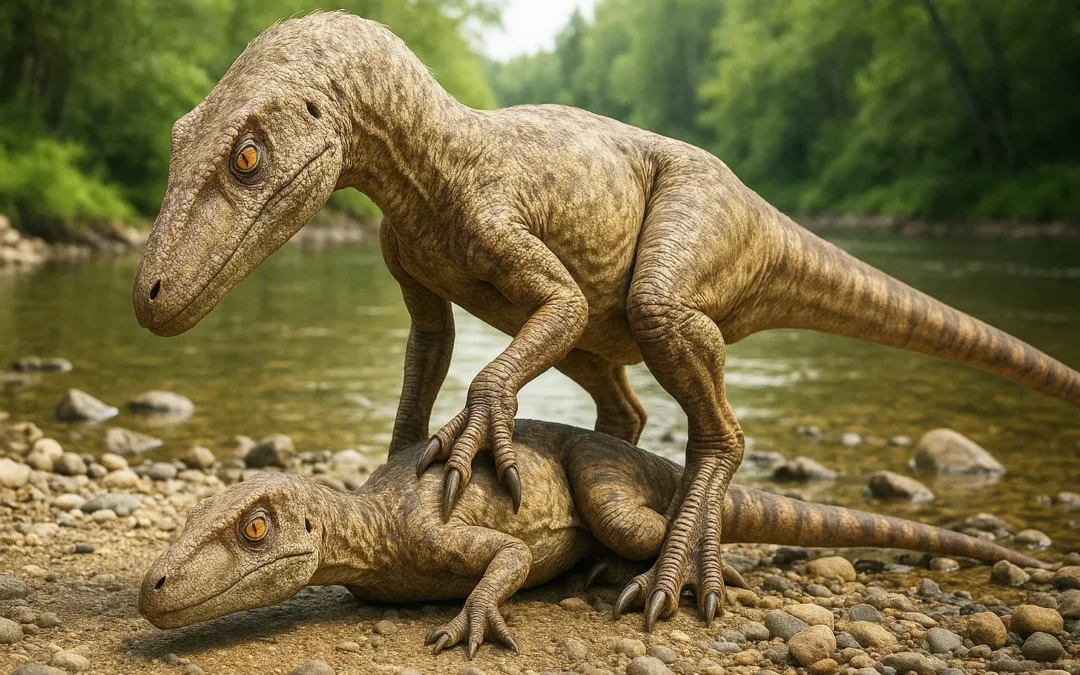
Terrence Malick’s The Tree of Life is a film that feels less like a story than a meditation—a cinematic sutra on suffering, impermanence, and the mystery of grace that maps our current condition as human beings. Among its most haunting scenes, a dinosaur presses its claw on the neck of a fallen creature, then inexplicably releases it. The moment seems to open a crack in time itself: the first breath of mercy in a world ruled by instinct. Could grace have existed before language—before the human mind learned to name it? Can we hope that deep instincts oppose greed, anger, and delusion?
Fossils speak only in fragments. They preserve bone and sediment, not intention. Yet in Buddhist thought, this incompleteness is the nature of all conditioned things: sabbe saṅkhārā aniccā—all formations are impermanent. To demand moral evidence from stone is to mistake the map for the terrain. The record of life, like the mind, reveals only partial truths. But that does not mean compassion was absent. Empathy, like consciousness, arises dependently—a relational event, not a possession. The dinosaur’s hesitation, whether real or imagined, may reveal the same dynamic the Buddha described: the moment when impulse meets awareness and does not complete itself. It is that moment that provides the seed of humanity.
Modern science tells us that many theropods, especially the dromaeosaurs, were ancestors of modern birds. To observe a raven problem-solve, a parrot comfort its mate, or a crow mourn its dead is to glimpse continuities that stretch back into the Mesozoic. Even crocodiles, often dismissed as relics of brutality, guard their young and coordinate hunts. Compassion, it seems, did not wait for mammals; it may be as old as life’s capacity to recognize itself in another, to reflect our Buddha nature.
Buddhism calls this interbeing: no life exists alone, and therefore no act is ever isolated. Every gesture, violent or merciful, ripples through the web of existence. Malick’s dinosaur, pausing above its prey, becomes a symbol of paṭicca-samuppāda—dependent origination—the truth that every phenomenon arises through relationship. To hesitate is to reveal that connection; to spare another life is to embody it.
Ethologists describe such hesitation as “inhibition behavior”: a predator withholding the fatal strike. The Buddha described ahiṃsā, non-harming, as the first flowering of wisdom. Between impulse and action lies awareness, and in that space, compassion takes root. The dinosaur’s pause may not be moral reasoning, but it is akin to mindfulness—the awakening that interrupts automaticity. In the Pali Canon, the Buddha teaches that all beings “tremble at violence, all fear death.” To sense this is to begin to walk the path of restraint.
Some small-bodied theropods possessed enlarged forebrains, capable of sensory and perhaps social complexity. Evolution, like the Eightfold Path, moves by small awakenings. The same nervous architecture that allowed one creature to hesitate may have laid the groundwork for empathy, parental care, even proto-altruism. When a raptor pauses before killing, we might be witnessing not confusion but the faint glimmer of what later cultures would call grace.
From a Buddhist view, this is not sentimental. It is simply the Dharma expressed in deep time. Life is the field of practice; saṃsāra—the endless cycle of birth and death—is not punishment but process. Compassion is not a human achievement but an emergent property of interdependence. The Bodhisattva ideal—that beings awaken not for themselves but for all others—rests on a truth written into evolution itself: life survives by cooperation as much as by competition.
Bonobos console. Elephants grieve. Even rats free trapped companions. These acts arise not from moral law but from the natural intelligence of connection. Malick’s imagined dinosaur, claw raised and mercy granted, enacts the Bodhisattva gesture before the word existed: the refusal to harm when harm is possible. It is karuṇā in its most ancient form—the trembling of the heart before another’s pain.
Whether such a moment truly occurred in prehistory is beside the point. What matters is what it reveals: that grace is not bestowed from above but discovered within the fabric of being. When the dinosaur lifts its foot, life pauses before it learns to speak, before it divides good from evil, before it becomes human.
Malick’s scene is an evolutionary koan:
When did compassion begin?
Before speech. Before thought. Before the first mind trembled before another.
In that silence, the Dharma was already stirring.
Amaury Cruz is a retired lawyer, writer, and political activist from South Carolina. He holds a bachelor’s in political science and a Juris Doctor. He’s a member of Sanghas in Florida, North Carolina, and New York.