
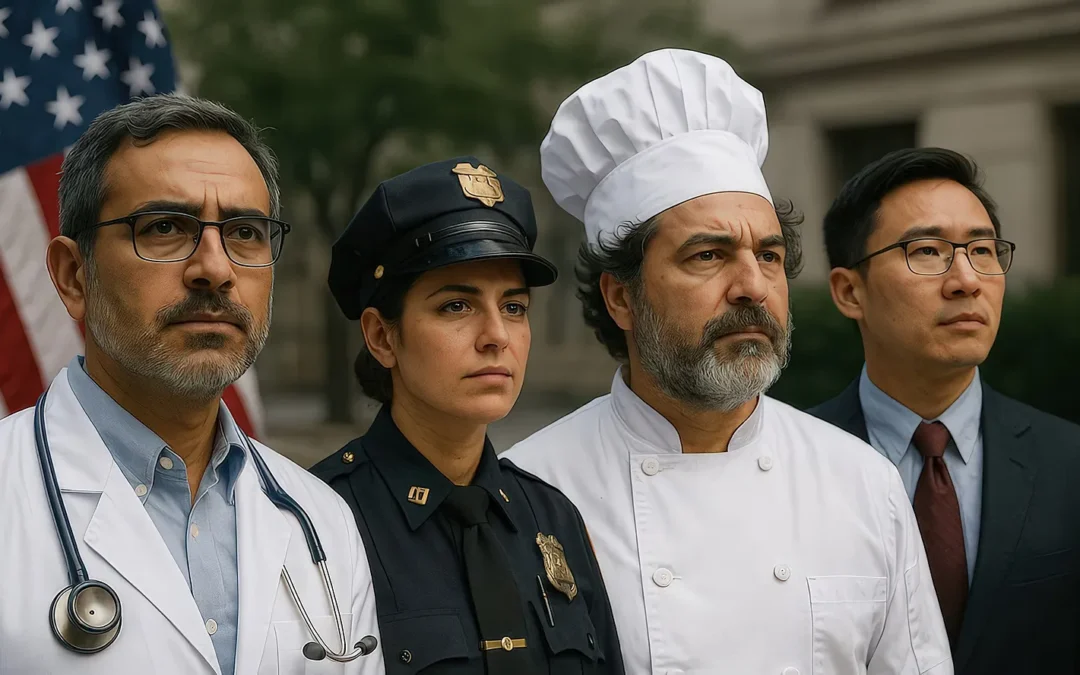
They arrive quietly, often unseen by the cameras that prefer the spectacle of the border or the flash of a crime scene. Yet the pulse of immigrant America beats in laboratories, kitchens, hospitals, and disaster zones across the country. It moves through the hands of men and women who have saved lives, advanced science, and rebuilt communities—acts that would seem made for television, if only television were looking.
Consider José Andrés, the Spanish-born chef who mobilized an army of cooks to feed survivors of hurricanes, earthquakes, and wars. He turned the simple act of feeding people into a form of moral resistance, demonstrating that compassion could scale as efficiently as commerce. Or Katalin Karikó, the Hungarian scientist whose work on mRNA paved the way for the COVID-19 vaccines that pulled the world back from the edge of catastrophe. For decades, her research was dismissed as marginal; only when it saved millions did her name emerge into the light. The same nation that once doubted immigrants’ worth relied on one to unlock the most consequential medical breakthrough of our time.
At the opposite end of the spectrum of fame stand figures like Officer Moira Smith, the Irish-born NYPD officer who spent the last minutes of her life carrying others out of the World Trade Center on September 11. There was also Lance Corporal José Antonio Gutierrez, who fled Guatemala’s civil war, reached the United States as a teenager, and later died serving the Marine Corps in Iraq—before he even had a chance to become a citizen. Their sacrifices were not symbols but realities, woven into the same national fabric that the evening news too often portrays as frayed by the presence of people like them.
Immigrants do not just fill gaps in the labor market; they create new worlds within it. Hamdi Ulukaya, a Kurdish refugee from Turkey, built Chobani into a billion-dollar company while insisting on worker dignity and refugee employment. Sergey Brin, who fled anti-Semitism in the Soviet Union, co-founded Google and helped redefine global communication. Fei-Fei Li, who came from China as a teenager, trained the algorithms that gave birth to modern artificial intelligence. The stories of these innovators are not exotic exceptions. They are expressions of a larger pattern: immigrants contributing ideas and energy that shape the future of every American industry.
In hospitals, on battlefields, in research labs and start-ups, in kitchens and classrooms, immigrants continually demonstrate the selflessness and ingenuity that the media claim to revere. Yet the dominant corporate narratives still focus elsewhere—on crime, illegality, and disorder. Flip through cable channels or scroll through political commentary and the immigrant remains a cipher for danger or dysfunction. Fox News, in particular, has perfected the formula: single out the wrongdoing of one undocumented person and turn it into a parable about an entire population. The immigrant becomes the lens through which American fear is refracted, not the mirror in which its vitality is reflected.
What disappears in this distortion are the quiet acts of solidarity that rarely make headlines. The Filipino nurses who died in the early months of the pandemic after weeks on the front line. The Syrian engineers who rebuild infrastructure in Midwestern towns hollowed out by deindustrialization. The DACA recipients tutoring American children during remote schooling, the Salvadoran farmworkers keeping food on tables while wildfires raged nearby. They represent the inverse of the media stereotype: people who sacrifice or risk their lives for a country that debates whether they belong in it.
The problem is not that the immigrant story lacks drama. It is that the drama defies the preferred scripts of conflict and decline. Heroism rooted in decency does not trend; empathy is not easily monetized. Networks want border raids and political theater, not an Iraqi-born biochemist discovering a cure, or a Guatemalan teenager earning a Bronze Star. Entertainment thrives on caricature. The immigrant character, when he appears, is the comic sidekick, the criminal, the maid, the convenience-store owner with broken English. Rarely is he the scientist, the founder, the composer, the surgeon.
This absence carries real consequences. Public attitudes harden around the images most frequently repeated. When the immigrant is seen primarily through the lens of threat, empathy contracts, and policies follow. Funding for immigrant entrepreneurship programs dwindles. Visa restrictions tighten. The cultural contributions of immigrants are dismissed as marginal, even when they dominate the creative industries. The American Immigration Council reports that immigrants make up more than ten percent of actors, musicians, and directors in the United States, yet you would scarcely know it from television or film. They fill our orchestras and galleries, but not our narratives.
There is no shortage of evidence to counter the distortion—only a shortage of will to display it. Journalists could easily tell stories of the Afghan interpreter turned firefighter, or the Haitian-American engineer designing climate-resilient housing, or the Kenyan coder who founded a health-tech startup in Detroit. Instead, they chase the flash of scandal, mistaking visibility for truth. The moral economy of attention rewards outrage, not contribution.
The deeper irony is that the media itself depends on immigrant labor and creativity. Many of its most successful companies, from Google to Disney to Paramount, were founded or co-founded by immigrants or their children. The very platforms through which right-wing pundits rail against immigration owe their existence to it. The selective memory borders on absurd: a system built by immigrants condemning immigration in the name of national purity.
Rebalancing the narrative will require more than token stories or diversity campaigns. It demands a shift in editorial priorities and cultural perspective. Newsrooms must see immigrant achievement as newsworthy; film studios must cast immigrants as central rather than peripheral. Producers, editors, and executives of immigrant heritage must occupy decision-making roles, not simply advisory ones. Audiences must learn to expect complexity, not just crisis.
Immigrants have been rebuilding this country since before it called itself a country. Their heroism does not always look like the headline version of valor. Sometimes it is the quiet persistence of a mother cleaning offices at night while her son finishes medical school. Sometimes it is the scientist spending a decade on an obscure line of research that will someday save lives. Sometimes it is the soldier, the nurse, the chef, the coder. What they share is a belief in possibility—the belief that work and compassion still matter in a place that often forgets both.
If the media truly reflected the nation it claims to cover, these would be the leading stories: the immigrant as innovator, caregiver, and citizen in every sense that counts. Until then, we remain trapped in a hall of mirrors built by fear, mistaking reflection for reality, while the true face of American heroism walks past the cameras, unrecorded.
Amaury Cruz is a writer, political activist, and retired lawyer living in South Carolina. He holds a bachelor’s in political science and a Juris Doctor.