
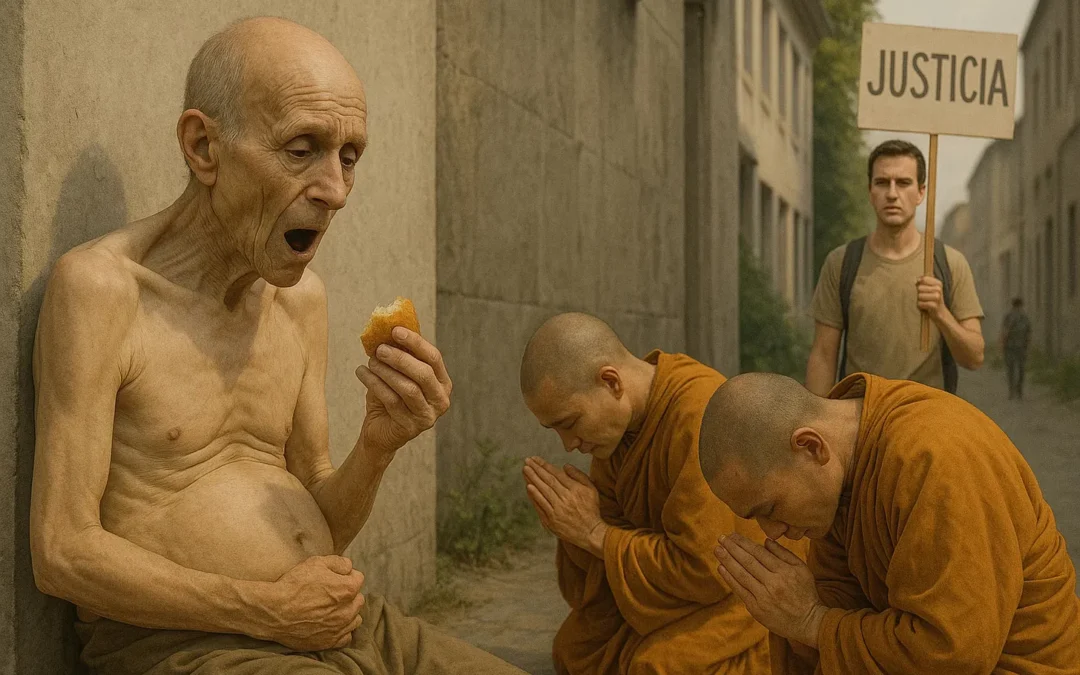
In Buddhist cosmology, the hungry ghosts—pretas—are beings with vast, empty bellies and narrow throats. They wander desolate landscapes tormented by unending craving. Some try to eat, but what enters their mouths turns to fire or ash. Their condition is not punishment from outside but the visible form of desire itself—wanting so intensely that one’s very being becomes hunger.
Modern activism often carries a similar affliction. Many who enter political life or social movements do so from compassion, outrage, or love for justice. They see suffering and want to end it. Yet over time, that wish can harden into something else: an identity built on opposition, a righteousness that feeds on frustration, a craving for purity or victory that can never be satisfied. The world resists transformation, and the activist’s spirit begins to mirror the ghost’s condition—burning, dry, insatiable.
The Karma of Good Intentions
The Petavatthu tells of beings reborn as hungry ghosts after lives of stinginess or deceit. But in a subtler sense, any mind that grasps—even at noble ends—enters the same realm. Craving is craving, whether for wealth, revenge, or utopia. The bodhisattva path warns of “compassion mixed with clinging,” where we try to save others without releasing our own need to control outcomes. In that sense, the hungry ghost is not only the miser or addict but also the reformer who cannot rest until the world conforms to their image of the good.
The Politics of Frustration
Contemporary activism amplifies this dynamic. Movements built on outrage risk becoming addicted to it. The constant cycle of crisis and reaction keeps the political metabolism inflamed. Every partial victory breeds new dissatisfaction. The more attention activists gain, the more they must consume to sustain it. Social media—our collective ghost realm—rewards outrage and purity tests over reflection and dialogue. The result is moral exhaustion masked as momentum.
The ghost’s huge belly and constricted throat capture this paradox: vast desire for justice, but little capacity for nourishment. Activists often starve for meaning even as they work ceaselessly for change. The energy that could heal the world burns itself out in anger, self-criticism, and despair.
Feeding the Ghosts with Wisdom
Buddhism does not condemn passion or compassion. It cautions against attachment—to results, recognition, or the idea of being right. The preta realm offers a mirror for activists: when our pursuit of good becomes compulsive, when we cannot rest until the world agrees with us, when our compassion breeds contempt for those who “don’t get it,” we are feeding our ghosts instead of transforming them.
To “feed” the hungry ghosts skillfully means to meet craving with awareness. In practice, this means cultivating patience and humility alongside righteous action. It means learning to act without needing to win. The Bodhisattva ideal is not passivity—it is steadfast engagement free of possession. When activism arises from that ground, energy replenishes itself instead of devouring itself.
The Middle Path of Change
The world needs passionate activists, but it needs them whole. A politics of awakening does not arise from exhaustion or rage; it arises from clarity. When we release the hunger for control, our work becomes service rather than struggle. We still act, but without fire in the throat.
The hungry ghosts remind us that the deepest revolution begins in the mind that acts. To change the world without being consumed by it—to feed the ghosts instead of joining them—is perhaps the hardest and most necessary act of liberation in our time.
Amaury Cruz is a retired lawyer, writer, and political activist from South Carolina. He holds a bachelor’s in political science and a Juris Doctor. He’s a member of sanghas in Florida, North Carolina, and New York.