
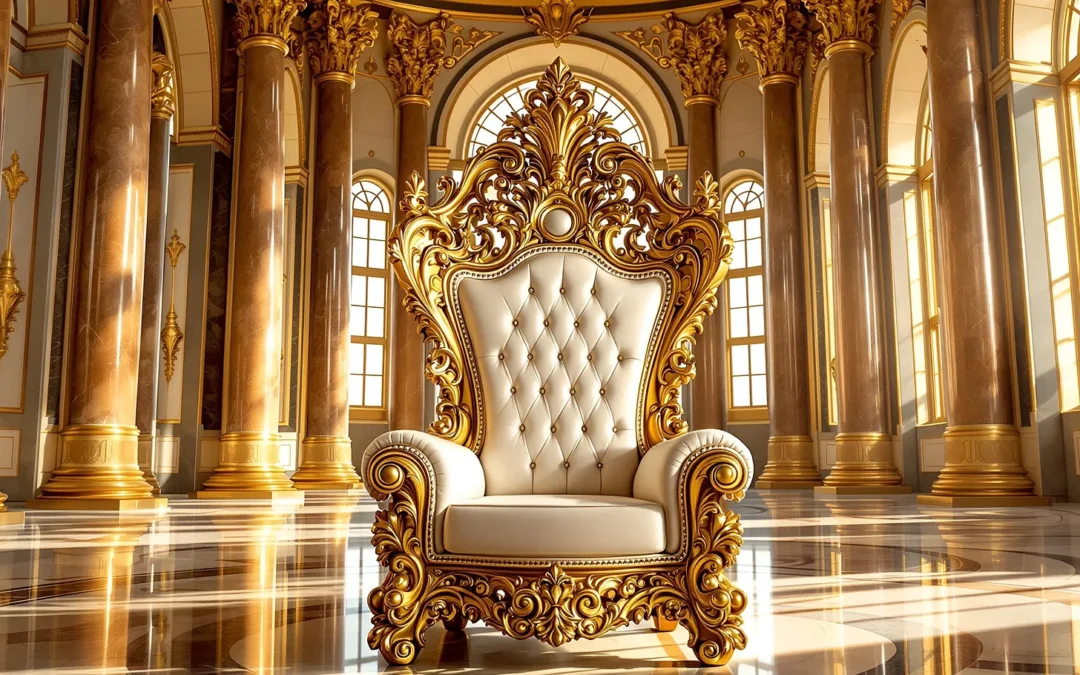
It’s hard to find the exact right word—le mot juste—that best describes the Trump regime. Words like “fascist,” “illiberal,” “personalist dictatorship,” and “authoritarian” are often used, but none seems completely satisfactory. Imagine my pleasure, then, when I recently came across a new term in an article by Stacie Goddard and Abraham Newman[1] that captures the essence of the Trump regime—and predicts what to expect from it in the future. Goddard and Newman’s term of art is Neo-Royalism, and it deserves to be better known.
They define Neo-Royalism as a structured system of hyper-elites who seek to legitimize their authority through appeals to their exceptionalism, and who strive to generate enormous material wealth and preeminent social status through the extraction of financial and social tributes. These hyper-elites swear fealty to an absolute sovereign whose patronage enables them to amass wealth, power, and status. They are uninterested in the well-being of non-elite members of society, and their power and influence extends beyond national borders. Absolute sovereigns— whether they hold the title of Khan, president, chairman, or mafia don—only respect rival absolute sovereigns with whom they can broker deals.
Neo-Royalism stands in marked contrast to the post-World War II liberal world order that emphasized respect for national sovereignty, equality among nation states, and the principle of non-interference between states. This order also emphasized free trade, collective security, and the establishment of cooperative institutions that helped establish and police international law. Nation states were said to have national interests that involved protecting their borders, securing the resources for economic growth, and extending their influence through military, economic, and cultural power. The legitimacy of states rested on their ability to improve the lives of their citizens.
This liberal world order was always more aspirational than real, but it worked to the degree to which nation states pretended to honor it. The number of people killed in wars between nation states declined sharply after 1945. Yale professor Oona Hathaway calculates that between 1989 -2014, battle-related deaths in wars between nations averaged fewer than 15,000 a year. Beginning in 2014, the average has risen to over 100,000 a year. If Neo-Royalism succeeds in becoming the dominant model of international relations, we can expect that number to continue to rise.
Interestingly, Neo-Royalism is only concerned with increasing the wealth, power, and status of hyper-elites and not with acting in the national interest or bettering the lives of a nation’s citizens. Confiscated Venezuelan oil, for example, will not benefit the United States or its citizens, but will benefit those who control its distribution and sale. That wealth will be offset by the cost of maintaining a military force off the Venezuelan cost which will be borne by the taxpayers. It was the same in the old days of British colonialism: The fiscal benefits of colonialism accrued to companies like the British East India Company, whereas it was the British taxpayer who paid the cost of maintaining British military power around the globe.
Neo-Royalist orders used to be more common in premodern times—think about the Mongol Khanate, the Medicis and the Habsburgs, or the Imperial Chinese tributary system. Contemporary Neo-Royal orders include the mafia, The House of Saud, and Putin’s oligarchy. We see Neo-Royalism at work as President Trump travels the world with family members and fellow multi-billionaires to make “trade” or “peace deals,” or when he intimidates and threatens former allies like Canada and Denmark. There is very little concern with whether life is affordable for the average American, whether people have healthcare, or whether children are vaccinated, but a great deal of interest in building artificial intelligence data centers, cryptocurrency schemes, and media conglomerates.
Hierarchy is the whole point of Neo-Royalist orders. Their purpose is to allow small cliques to maintain and enhance their dominance in wealth and status. They reject notions of equality and noninterference, only recognizing rival “great cliques” as peers. Power is maintained through rents, tributes, extortion, and bribes. Collaboration within the hyper-elite is like the collaboration in mafioso systems and protection rackets.
Of course, the degree to which any society creates and enforces rules that maximize general well-being, and the degree to which they function as corrupt kleptocratic oligarchies is always just a matter of degree. All too often, naked greed and force are disguised through paying lip service to democratic ideals. What is shocking now is the degree to which the hyper-elites now feel liberated to say the quiet parts aloud.
There was a time when America took pride in its contributions to quality of life—the creation of public schools, libraries, community colleges, great universities, cultural centers, public health systems, social security, Medicare, the 40-hour work week, food inspection, clean air and water, worker’s safety regulations, the public highway system, and rural electrification. None of this matters much to the hyper-elites that now dominate American society. The public can go to hell, as long as the elites can go to Mars, build AGI, or make their next billion.
Powerful nations states are now free to pick off weaker ones, whether Venezuela, Ukraine, Greenland, or Taiwan. If the U.S. succeeds in devouring Greenland and Russia succeeds in devouring Ukraine, which European nation will be devoured next? Moldova? Poland? The Baltics? There’s no end to this unraveling once it gets started.
America has always had its hyper-elites. Think back to the gilded age of the Mellons, Carnegies, and Morgans, or later-era oil barons like the Rockefellers. What’s new is the normalization of a gangster-thug president who sees no limits to his powers and the speed in which hyper-elites have fallen in line for favor and influence. In addition, the gilded age hyper-elites at least felt obliged to make magnanimous shows of giving back to society, building museums, concert halls, libraries, and charitable foundations. With a handful of exceptions, most of today’s multi-billionaires can’t even bother to pretend.
The trouble is, we all know where this story ends. There’s a reason why the liberal world order was created—it was born out of the tragedies of two World Wars. When people stop caring or even pretending to care about virtue, the world becomes an arena for the raw exercise of power and life becomes a war of all against all. As Ferdinand declares in Shakespeare’s The Tempest, “Hell is empty and all the devils are here.”
Goddard and Newman argue that it is not inevitable that the Neo-Royalist world order will prevail. There are sectors of the national and international public (including some elites) that are not on board with this transformation. Perhaps Europe can create collective security arrangements that do not depend on the U.S. and can resist American and Russian aggression. Perhaps the midterm elections in the U.S. will repudiate Neo-Royalism and create a new powerbase that can curtail its worst excesses. Perhaps courageous young rising politicians can ignite hope and create a groundswell of popular support for a new age of reform.
Meanwhile, we Buddhists view all this through the lens of the Dharma. Neo-Royalism is the institutionalized embodiment of greed, aggression, and delusion. If we can view it with clear eyes, we have a better idea of how to resist, what we are organizing to change, and the kinds of civic virtue we aim to restore. We also believe in karma— that greed, aggression, and delusion contain the seeds of their own demise. We don’t believe that caring, fairness, mutual respect, and genuine cooperation are for weaklings or suckers— they are the essential keys to good and happy lives. The Dharma may sometimes be partially eclipsed, but it is always ready to be rediscovered anew.
And we have faith that conceptions of fairness and the rights of individuals to express themselves and pursue their dreams are by now so deeply ingrained in human consciousness that they cannot be totally suppressed or irradicated.
We need to understand Neo-Royalism for what it is, and it helps that we now have a name for it.
Thank you, Stacie Goddard and Abraham Newman!
[1] Goddard SE, Newman A. Further Back to the Future: Neo-Royalism, the Trump Administration, and the Emerging International System. International Organization. 2025;79(S1):S12-S25. doi:10.1017/S0020818325101057