
When I found out about the mission of their walk, something inside me cracked.
Not metaphorically, but physically.
Tears came before thought. I felt heat building in my chest, and a sense of relief moved through me like melting ice. And underneath all of that, something I didn’t expect began surfacing. I noticed a type of harsh self-judgment, almost a feeling of being fundamentally flawed because I had almost grown numb to the division we are seeing and experiencing in our current world, where the persistent narrative tells us that peace only survives behind protection, behind control.
And then I saw the Venerable Monks.
Immigrants, replanted humans who became monks in saffron robes, walking through U.S. suburbs and cities in brutal climates and freezing cold. Walking, sometimes barefoot, from Texas to Washington, D.C. Not marching. Not shouting. They are just walking. Unarmed and well accompanied by their loyal companion, Aloka.
Seeing them walk broke my heart open to the hope that peace not obtained at the end of a rifle is possible.
Walking in Peace Instead of Performing
For weeks, I had been detaching from the news for the sake of my own self-care and mental well-being. So many names listed in files. So much cruelty disguised as leadership. So many people claiming to bring solutions for a better world while thriving on division. And the message of peace spoken loudly, with weapons resting somewhere in the background.
All of that kept me curious and questioning things like:
What if peace were no longer used as a cover for division?
What would it mean to stop claiming we hold the remedy for a better world while sharpening separation?
I want to invite us to pause for a moment and truly observe what this group of humans has done for all of us. They are unifying communities without force. They are showing self-regulation when their lives are in danger. They are walking through hostility and responding with peaceful, sincere curiosity. People from all walks of life have been drawn to their mission and are carrying their message of peaceful living.
And when I see that, I cannot help but notice how deeply hungry we must be for peace — not the kind declared from a podium, but the kind embodied step by step, day by day.
The kind of peace the Venerable Monks are not yelling about — they are walking it.
Many of them come from places like Vietnam and other Southeast Asian communities shaped by diaspora — places where war is not theory but memory. And here they are, walking unarmed, showing compassion to all beings, through a country historically connected to the armed conflicts that shaped many Southeast Asian Buddhist communities now living here.
And this realization made me dive even deeper. I caught a glimpse of understanding, and something in me recognized that peace is possible when it begins within.
Not as performance.
Not as branding.
Not as moral superiority.
But within.
When Peace Walked Past My House
Living minutes from Washington, D.C., has its advantages. I have access to remarkable events that shape history, and I debated whether to go downtown for the large gathering with the Venerable Monks. My nervous system has its own history. Migration has left traces in my body. Crowds, especially in tense environments, can easily awaken hyper-alert patterns I did not choose but still carry.
In moments of introspection, the critical part of my inner voice kept delivering messages that felt almost like commands:
Lorena, you have to go.
You have to document everything.
You will regret not being seen in this historic moment.
People need to see that you care.
But when I approached that same inner voice gently, with sweetness, and asked, What are you trying to prove? What are you afraid of losing? — something softened. The urgency loosened. And I realized something humbling.
I wasn’t afraid of missing history.
I was afraid of not belonging inside it — of not being seen, of not standing on the “right” side of it, of disappearing from it altogether.
And yet, the reality was simple.
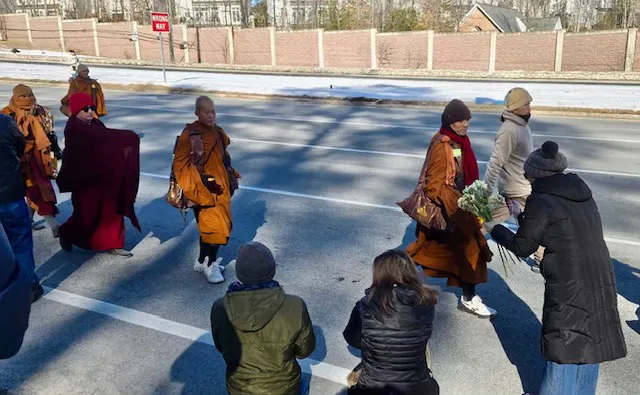
The Venerable Monks walked past my house in Virginia and had smaller gatherings compared to what was expected in Washington, D.C. I handed them flowers, and they handed flowers back. And between their walk through my neighborhood and attending their gatherings, three times I stood less than five feet away from them, my body shaking in the cold while my chest warmed with something ancient, listening as they reminded us that walking with them in spirit is also part of the teaching.
I had already been there.
And still, a part of me wanted proof.
Maybe my hunger was not only for peace, but to be seen inside it. Watching them walk, unarmed and steady, I began to understand something quieter. Peace does not require an audience. And in that stillness, I wondered what kind of peace I would want to carry if today were my last day walking this Earth.
The wisdom of the Venerable Monks and the teachings they embody feels quietly humbling. They have been met with hostility. Some have even been endangered. And yet they continue to respond with peace, without escalation.
Being both a spectator and a participant in this monumental moment in history, I kept returning to something simple: compassion is not weakness. Science reminds us that it is an ancient evolutionary capacity — that before our impulses toward control and power, we were wired for care for one another and for non-human beings as well.
Following their path, I remembered something older than opinions or positions. I remembered that we are capable of disarming ourselves.
In times that reward aggression and where division seems to be the common language, small acts begin to feel almost heroic. A quiet walk becomes revolutionary when a culture forgets how to listen. And we are witnessing, in real time, how peace that stands on the other side of a gun still carries the logic of separation. But peace that begins in the heart-mind — in the sentipensante body — moves differently. It softens borders. It reminds us that we can live as brothers and sisters, children of the same Earth.
Seeing them walk by my house, being in their presence as they delivered their message, did not fix the world.
But it broke my heart open.
And through that crack, hope ignited, and I remembered that I have the capacity to be in peace.
My prayer is to keep that hope as my center of gravity moving forward. To keep writing and reading every day this simple, yet potent statement that has become a mantra for many:
“Today will be my peaceful day.”
And to close this recollection of my experience, I return to these simple words we may all recognize:
May you be happy.
May you be safe.
May you be free from suffering and live in peace.
And may we find the courage to soften the wars within us and remember each other beyond the battles we carry within.
Dear Lorena,
It’s Tues., July 21, and unbelievably I’m just beginning to read the powerful, eloquent articles in the Blog section of the amazing BCD website.
The openness of what you share so eloquently touches me deeply.
I bow to you and with you with huge gratitude and good wishes.