
Back in the 1990s —before the era of social media—when Usenet was the most common venue for internet conversations— it was noted that the longer an online discussion continued, the greater the probability that one person would end up comparing another to Hitler. This was jokingly formalized as Godwin’s Law: as an online discussion grows longer, the probability of someone comparing someone else to Hitler approaches one. In those days, of course, the odds that someone was conversing with an actual Nazi were almost zero. Godwin’s Law was a description of hyperbole run amok.
These days, the odds that one is conversing with an actual Nazi are much greater. In an interview with the Boston Globe in the aftermath of the murders of Renee Good and Alex Pretti, essayist and humorist Fran Leibowitz stated, “many of my friends have always been way to the left of me, and I’ve always argued with them. I’ve spent decades saying to people, ‘No, no, you’re not right. No, this isn’t like Hitler.’ But things have changed. This is exactly like Hitler. This is exactly what the Nazis did. This is not kind of like what the Nazis did. This is precisely what the Nazis did.” We have reached an era when comparisons to fascism are no longer hyperbole but the simple act of calling a spade a spade.
When one thinks “Nazis” one thinks “secret police” and “concentration camps.” DHS, ICE, and CBP currently occupy a grey area between being legitimate police agencies and being organs of what Ernst Fraenkel termed the “prerogative” state — like the Nazi S.S., S.A., and Gestapo. They regularly break into people’s homes without judicial warrants. Their masks, lack of visible identification, and makeshift military-style uniforms symbolize their irregularity. They are outfits intended to intimidate rather than uniforms meant to identify them as law enforcement. Recruitment requirements, training, and internal discipline are inadequate. According to CPB’s own internal reports, CPB agents are arrested for criminal offenses (domestic violence, drunk driving, etc.) at five times the rate of officers from other federal police agencies.
The immigrant detention system can also be legitimately compared to an archipelago of concentration camps dotting the American landscape. They, too, resemble organs of the prerogative state. The system is largely lawless and people who fall into its grasp are denied their basic humanity and normal civil liberties. So far, judges have ruled that over 4,000 of its detentions violated basic civil liberties. While it is true that these camps are not death camps in the sense that Auschwitz was—their purpose is not extermination but extrication—they are nevertheless a means of removing people from the normative state and placing them at the mercy of the prerogative state. And like the Nazis, there is a racist rationale underlying the entire enterprise: When ICE goes to Minneapolis, it looks primarily for Somalis; if it goes into Springfield, Ohio, it will look primarily for Haitians. It almost always focuses on brown and black people. Yes, other nationalities occasionally get caught up in its dragnets, but that seems almost incidental to its primary purpose.
DHS currently holds approximately 70,000 immigrants in its concentration camps, and it is planning on spending $38 billion to buy up warehouses and retrofit them to hold an additional 70,000 inmates (at a price of approximately a half million dollars per inmate—someone is getting rich!). Over 85% of immigrants are detained in private for-profit detention centers owned and managed by CoreCivic, the GEO Group, LaSalle Corrections, and the Management and Training Corporation. These companies make their money off the misery of immigrants, with CoreCivic earning a profit of over $100,000,000 this past year. In order to squeeze out maximum profit for its shareholders, immigrants are crowded into substandard living spaces and denied basic healthcare and other necessities.
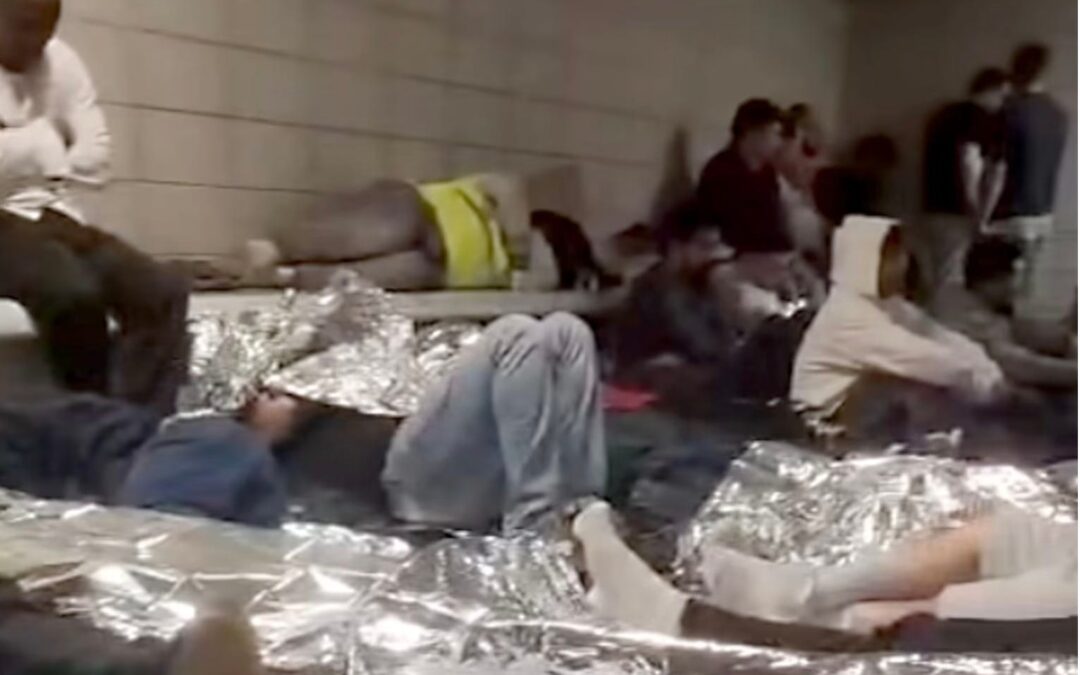
Conditions in these prisons are abominable. On February 12, U.S. Representative Jamie Raskin conducted an unannounced oversight visit of an ICE detention facility in Baltimore. He saw 60 men packed shoulder-to-shoulder in a single room, 24-hours-a-day, with a single toilet and no shower facilities. They slept “like sardines with aluminum foil blankets.” This concords with a video shot at the Baltimore facility in January (the photo above is from that video). Needless to say, detainees receive only minimal and at best sporadic healthcare. Most of those held in these facilities, sometimes for over a year, have no outstanding criminal warrants, but are denied the same right to release on bail that criminals have.
A recent New York Times expose of health care within CoreCivic facilities revealed inadequate nursing staff, patients deprived of lifesaving medications, and a reluctance to hospitalize patients with life-endangering conditions. Thirty-one detainees died in ICE custody in 2025. Earlier this month, a 33-year-old Columbia University student, Leqaa Kordia, was taken to the hospital after a seizure suffered while in the Prarieland Detention Facility in Alvarado, Texas where she has been detained for eleven months. She was arrested in April 2024 for participating in a Pro-Palestinian demonstration at Columbia University, but charges against her were dismissed and sealed. She was detained by ICE when she went for a routine immigration hearing and has been confined for the past year despite a judge ruling (twice!) that she be released on bond. DHS appealed the judge’s decision and continues to detain her as the appeals process winds its way through the courts.
If a February 6th U.S. Court of Appeals for the Fifth Circuit ruling stands, judges have now lost their ability to demand detained immigrants be released on bail. That ruling states that unlike citizen criminals, immigrants have no right to bail. This ruling overturns 30 years of legal precedent—and it’s anyone’s guess when and whether the Supreme Court will eventually put things aright. In the meantime, tens of thousands of immigrants are being deprived of rights guaranteed them under the Constitution. We have created a privatized for-profit American Gulag Archipelago in which people are detained indefinitely with no history of criminal activity and without recourse to bail. Keep in mind that just being in the country “illegally” (crossing the border illegally or overstaying a visa) is a civil matter and not a criminal one. In addition, many detainees are not even in the country illegally. Many are awaiting an asylum decision, or on temporary protected status, or have been issued green cards.
What is the proper Buddhist response to unjust policing and detainment policies? The first is to be aware, to witness, and not turn away.
The second is to refuse to participate in inhumane and unlawful actions—to not cooperate with ICE agents when they lack judicial warrants, and to not own stock in private for-profit prisons. This is in line with the Buddhist principle of ahimsa.
The third is to protect the vulnerable. Communities can organize to provide food and other assistance to immigrants who are afraid to leave their homes, go to school, or go to work when ICE is in town.
The fourth is non-violent civil disobedience as demonstrated by the clergy who were arrested when they knelt to pray at the Minneapolis airport and by the many good citizens of Minneapolis who peacefully put their bodies between ICE and CPB agents and their intended victims, and who stood up to their neighbors in the subzero cold. If a warehouse in your town is being bought by ICE to convert into a detention facility, demonstrate in front of the warehouse, testify at planning and zoning board meetings to slow down the approval process, and urge the warehouse owners not to sell.
The fifth is to do what we can to change people’s minds—to engage in right speech: to talk with our neighbors, to write to our representatives, to vote for people who promise to try to put an end to this, or to run for office ourselves. A vibrant and resilient civil society is the best bulwark against fascism. Don’t be isolated or feel helpless or alone. Join together with others in religious, civic, legal, and political organizations. Donate to organizations that give legal counsel to immigrants or sue on behalf of protecting our civil liberties.
And most of all, don’t allow yourself to be intimidated. DHS is currently requesting that social media companies turn over information on the owners of websites that post anti-ICE content. This is their attempt to frighten everyone into submission and silence. While it is only natural to experience fear, it is crucial that we live out our values without bowing unduly to it. Anything else is a betrayal of our Buddha-nature.
Is it right speech to use “fascist” as a descriptor for many of the actions this administration is taking? A lot depends on your intent. If your purpose is to inflame passions, probably not. If your purpose is to accurately diagnose our national illness, it may be presisely right. The other question is whether is is politically wise—in the long run, does it lead to constructive engagement, or does it lead to harmful consequences? Does using the word “fascist” help more people to understand the dire nature of this moment and motivate them to act to protect civil liberties, or does it only serve to alienate them? Only time will tell.