
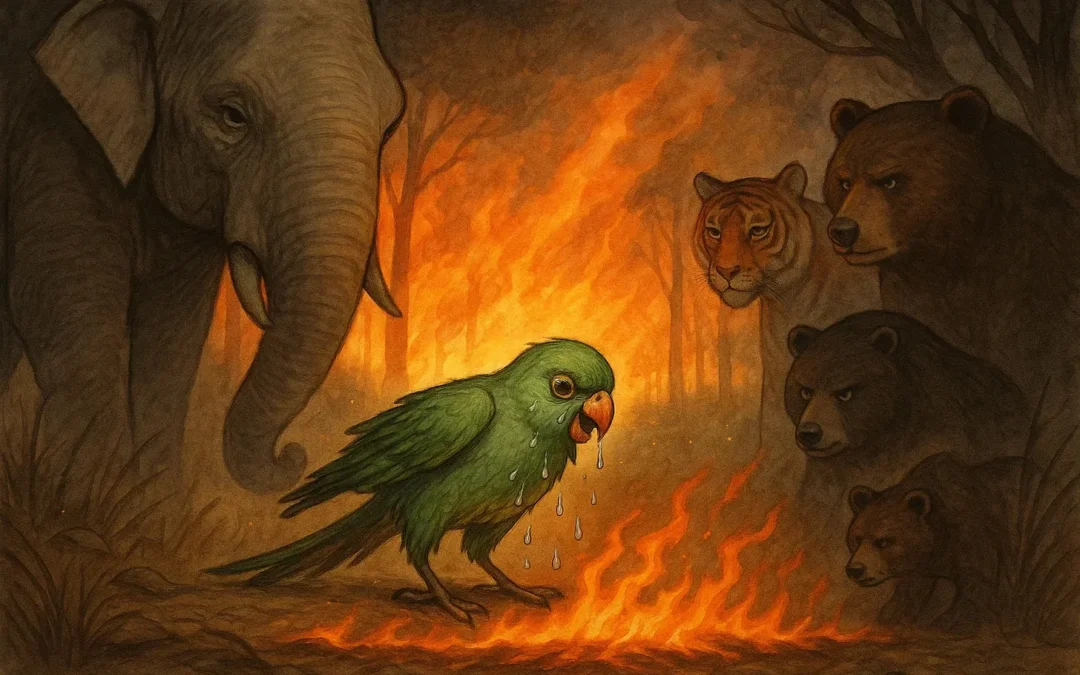
There’s an old Jataka tale about a small parrot trying to put out a forest fire. You’ve probably heard some version of it.
The fire doesn’t start as an inferno. It begins as a barely visible line of orange, like someone dragging a hot wire across the horizon. The villagers notice. They chatter. Then they go back to whatever kept them busy. A bit later, the fire is an inferno. The usual chorus is heard: “Too big.” “Not my problem.” “Somebody else’s job.” Some are unfortunately unable to act: the old, the incapacitated, the sick, the children.
But the parrot feels the heat, literal heat, and something in it refuses to look away. It flies to the river, dunks itself, and comes back shaking a few pitiful drops on the flames. It’s sad how little it accomplishes. The forest just crackles in response, louder each time.
From the shadows, the big animals, the ones who supposedly matter, the elephant, the tiger, the bear, watch like jaded spectators. They heckle. They lecture. They call it foolish. “You’ll die before you make a dent.” In other stories, this is where the parrot would take the hint and quit. But it doesn’t. It goes back for another dip, its singed wings trembling, vision blurring, time and time again, acting not from optimism but something closer to indefatigable conscience.
A god eventually appears (because such stories need a jump-the-shark point) and asks, “Why do this? You’re not going to put out the fire.” And the parrot, exhausted, half-burned, answers, “Because this is my forest.” Nothing profound. Just ownership, responsibility, maybe love. The god cries, its tears become heavy rain, and the fire dies.
The tale is simple, almost naive. But it lingers.
I think about that parrot every time someone shrugs and says political activism is pointless. You know the story: “Nothing changes.” “They’re all the same.” “Why bother?” The voices sound different now, but the logic is identical to the beasts sitting comfortably on the sidelines. Call it realism, call it cynicism, call it survival—what it often is, underneath, is surrender dressed up as street smarts. Or maybe the detachment of privilege: “my ETFs are doing great.”
The modern forest is both literally burning as well as by metaphor. Government lies, over thirty-thousand times by the president alone in four years. Institutions rot. Rights shrink. Democracy starts to become a quaint notion. The smoke is everywhere. And still many people insist there’s “no point” in showing up. Meanwhile the great beasts of our age—billionaires, party machines, pundits—sit around the blaze explaining why those with the least power should do the most work.
The truth is that political action usually looks ridiculous up close. A vote, a sign, a letter, a conversation with a friend who’d prefer not to think about any of this. A few pathetic drops from soaked feathers. Most results don’t arrive in one lifetime. Sometimes they don’t arrive at all. But history only moves because someone, somewhere, refuses the comfortable seat among the spectators.
Think about Rosa Parks on the bus. Think about Václav Havel writing his essays to a readership that almost no one read. Greta Thunberg, a kid with a cardboard sign in the bitter cold. None of them had the luxury of certainty. None started out expecting anything. They acted because not acting would have corrupted something inside them.
Political activism rarely begins with hope. It begins with discomfort—sometimes shame—at the idea of sitting with the beasts and pretending that impotence is insight.
Every age gets its fire. Ours is a whole cluster of them: climate collapse, democratic decay, a culture that rewards indifference as if it were wisdom. And yet the lesson stands. Someone has to fly toward the heat first, not because that will necessarily save the forest, but because turning away feels like a small kind of death.
A few drops at a time is how every turning begins. No gods required. Just people who decide they’d rather burn their wings than watch the world go up in smoke. The parrot is still out there, flying its incomprehensible, heroic loops. The only real question left is whether we’re going to join the firefighting or keep practicing our speeches about why it’s pointless to care.