
May Day has come and gone.
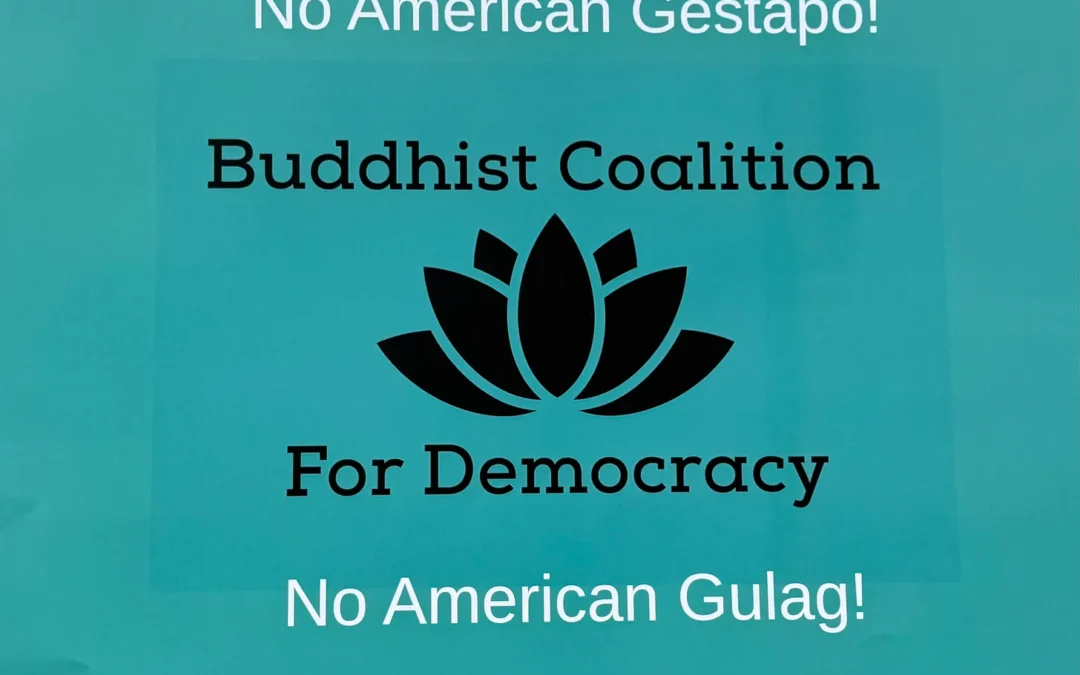
I couldn’t stay home from work because I’m retired, and I couldn’t stay home from school because I’m not a student, but I abstained from shopping and attended my town’s local May Day Strong demonstration—one of 5,000 across the country. The demonstration was a little bit larger than the usual weekly demonstration—maybe a few dozen people. I carried the placard in the image above. We were honked at by friendly passers-by, but the sheer volume of cars passing by meant most folks were going about their business as usual. If this was, as Indivisible suggested, a test of our collective readiness for a national strike, then we failed.
With everything that has happened in the past year, why are we not on the brink of a national strike? One reason is that mass actions require specific triggers—dramatic events that focus the national attention—like the murder of George Floyd, Renée Good, or Alex Pretti. Or the initiation of the war in Iran.
What makes a specific event serve as a trigger is a bit of a mystery. People die in ICE custody every week; people are wrongfully detained and deported every hour. Sometimes it’s because something’s caught on a smartphone camera—some image that’s eminently meme-able. You can’t predict in advance when such moments will occur.
The events of last week, as awful as they were, were not camera-friendly, nor were they of sufficient magnitude. While the decisions to prosecute the SPLC and James Comey, challenge ABC’s broadcast license, decimate the Voting Rights Act, and ban the mailing of mifepristone were awful each in their own way, they are not the kinds of events that bring people out in the streets or make them willingly sacrifice a paycheck. None were accompanied by a heart-rending image that captured people’s imaginations. The Iran War has been dragging on for months; people may not like it, but they are over the initial shock and outrage. Each of these stories was just one more piece of bad news in a year filled with bad news. People become accustomed and tune out. People’s attention spans are short, and tomorrow there’s another outrage to shake one’s head at. Trump’s strategy of flooding the zone works in his favor: More bad news from Trump? “What did you expect?” “You can’t react to everything!” Sometimes progressives say, “don’t let this latest outrage distract you,” but with Trump, everything is a distraction from everything else.
Another problem with May Day Strong was the organizers’ failure to enlist national mainstream organizations. If you look at the organizations that signed on to May Day Strong on their webpage, they are mostly local, small, and/or fringe organizations. For example, the Forthill Freedom Frogs, the Sound of Nothing Project, Fourth Branch Action, and the Pink Poster Project were all signatories. While these may all be fine organizations, they aren’t capable of generating high levels of national turnout. Other frequent signers were individual chapters of Indivisible and the Democratic Socialist for America. For a true national strike, you need sign-on from all or most of the significant segments of society—national labor unions, national civil rights organizations, national women’s organizations, national climate action organizations, national civil liberties organizations, national religious organizations, national political parties, and so on. Organizations like the SEIU, AFSCME, the UAW and the AFT, the NAACP, the ACLU, the National Council of Churches, the Sierra Club, and NOW. While some labor union locals and some local Democratic Party caucuses signed on, most of progressive civil society did not. There was a dearth of national spokespersons for the event. There was hardly any media attention beforehand, even within liberal media enclaves like Bluesky.
Why wasn’t there more sign-on from national organizations? I’m not party to these kinds of discussions and can’t be sure. How much effort does Indivisible put into networking with other organizations? Since it’s largely a decentralized hub of local organizations, does it have the capacity to liaison at a national level? Was the anti-billionaire message of May Day Strong a turn-off to organizations with other priorities? Some of these organizations may have seen May Day Strong as too different from and a distraction from their primary missions. Others might have seen it as uneccessarily putting a target on their backs.
Perhaps we need a kind of mahasangha of national civic organizations—a national pro-democracy civic organization conference that meets regularly to maintain inter-organizational collaboration. I am thinking back to the Reverend Martin Luther King Jr.’s March on Washington which was supported not only by all the major civil rights organizations (SCLC, NAACP, CORE, SNCC, and the National Urbal League) but also the UAW, The Brotherhood of Sleeping Car Porters, and various other AFL-CIO affiliates, The National Council of Churches, the United States Council of Catholic Bishops, and the American Jewish Congress. Part of the ability to pull this off was due to the presence of charasmatic national leaders like Dr. King and organizational geniuses like Bayard Rustin. All this is a reminder that we do not yet have a truely unified national resistence movement. Movements that succeed have national spokespersons, organizational structure, and specfic demands. One may think not only of the American civil rights, labor, and suffrage movements, but also of Lech Wałęsa, Solidarność, and the Catholic chuch in Poland.
I will leave it to those in the know to perform the post-mortem on why this action showcased the weaknesses of the resistance rather than its strengths. It’s not a mistake to try new ideas, and not everything thing we attempt will succeed. I’m glad the Buddhist Coalition for Democracy supported May Day Strong, and I’m glad I participated in it.
But it’s important to learn from our failures and not repeat them. What is the next step for the movement to preserve and enhance democracy? In the immediate future, our efforts need to stay focused on the courts and the midterms. A national strike is a fine idea—I wish it had already happened— but as of this moment, it’s still in the realm of fantasy.