
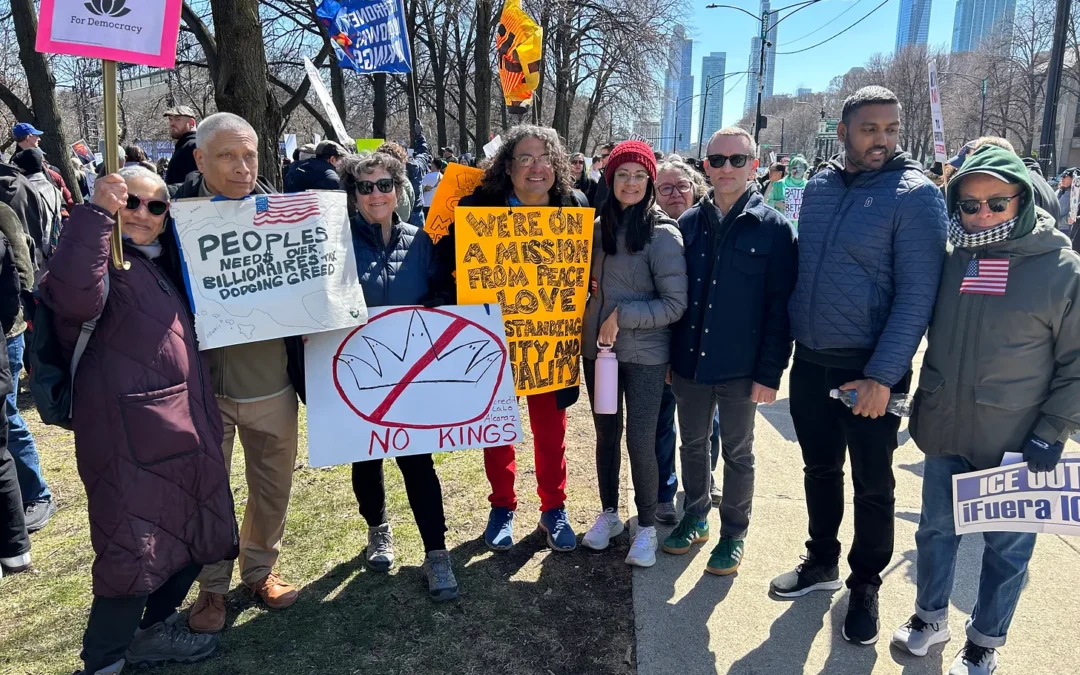
No Kings Day 3 has come and gone. An estimated 8,000,000 people participated—we’ll never know the exact number—but the more important question is “what happens next?” I attended a smallish No Kings Day demonstration—one of seven in Westchester County, NY that day—along with a handful of other Buddhists. Overall, there were about 1,300 people in attendance. The weather was nippy. A youngish woman wearing a plastic crown played patriotic anthems on a trumpet while the crowd happily sang along. Our local congressman showed up—the first time I’ve seen him at a No Kings event—chatting with constituents in the crowd about the idiocies of the Iran war.
The Wednesday before this No Kings Day, Linda Modaro asked her BCD weekly meditation group, “What does it mean to be counted?” A lot of folks toss around the “Chenowith number” that claims that when 3.5% of the population becomes involved in protests regime change is likely to occur. The number comes from Erica Chenowith’s and Maria Stephen’s book Why Civil Resistance Works: The Strategic Logic of Nonviolent Conflict. By that logic, only about 2.3 % of the U.S. Population turned out Saturday, so we haven’t quite hit the number. I have never much been impressed by the Chenowith number, however. I think it lends a false mathematical precision to what is the outcome of innumerable sets of ever-shifting causes, conditions, and circumstances. Beyond the mathematical meaning of “being counted,” however, Linda was asking the meditation group to consider the deeper question of what is it we do that really counts.
What really counts? I think there are multiple answers to the question. One is a more superficial answer: primary day for most of the country is less than three months away, and election day 218 days away. The energy of demonstrations needs to be channeled into the organization, turn out, and candidate selection that turns profound but often unfocused emotions into concrete institutional change. We need to transform the nearly moribund Democratic party into a party committed to improving the average person’s lot and not just pleasing its hyper-elite donors. Continuing to show up at rallies, demonstrations, and town halls and participate in boycotts are all part of what’s needed, but only part. By themselves, they can accomplish little unless they can help to alter the outcome of the next election. Even accomplishing that will not, in itself, put an end to our national nightmare, but it will at least establish a beachhead for continued and growing resistance.
A deeper answer to what really counts: the myriad ways in which we counter a regime based on deceit, division, greed, and hatred to re-knit the bonds that tie us all together. Every act of caring, compassion, support, and honesty helps re-weave the damaged fabric of our collective existence.
In my local community, I see some early signs of this re-weaving. Our community once had a vibrant interfaith clerical organization where priests, ministers, and rabbis met regularly to insure interfaith collaboration. That clerical community fell apart due to COVID and clerical retirements and transfers. The good news is that local clergy is reinstituting an interfaith clerical group this April. Interfaith collaboration can form the backbone of needed resistance if and when we face an ICE invasion like the one faced by Minneapolis. Our local immigrant community is largely Roman Catholic, Episcopal, and Pentecostal and these denominations can work together along with the support of their interfaith brothers and sisters in times of urgent need.
Another local sign of community renewal is the formation of a Central Westchester chapter of Indivisible. There are other Indivisible chapters in Westchester, but none in the immediate vicinity. Central Westchester Indivisible held its first general membership meeting last week. Although the group was just getting its sea legs, it already had a mailing list of several hundred people and planned a No Kings rally outside the local Town Hall. The Town Supervisor came and welcomed the formation of this new Indivisible chapter. I think the growing willingness of local politicians to attend Indivisible sponsored events—whether my Town Supervisor or my Congressman—is a sign of the growing acceptability and influence of the movement, and one way No Kings events may influence the political calculus. Local politicians may not be leading the charge, but they now see being associated with the movement as an asset.
Of course, our Buddhist Coalition for Democracy is another manifestation of this effort to re-weave civil society. We are striving to build a community based on caring and compassion—one is which all our members can feel counted and be called upon do what counts. Serge Prengel just renamed his monthly BCD “Mindful Conversations” group as “10% More Engaged.” We’re all looking for appropriate ways to find our personal routes to greater engagement. Together we can re-weave the communities we live in—our families, friends, neighbors, co-workers, and Sanghas—as part of a larger social fabric in which we all can experience a sense of agency and belonging, of having a voice that’s valued, and being cared about.