
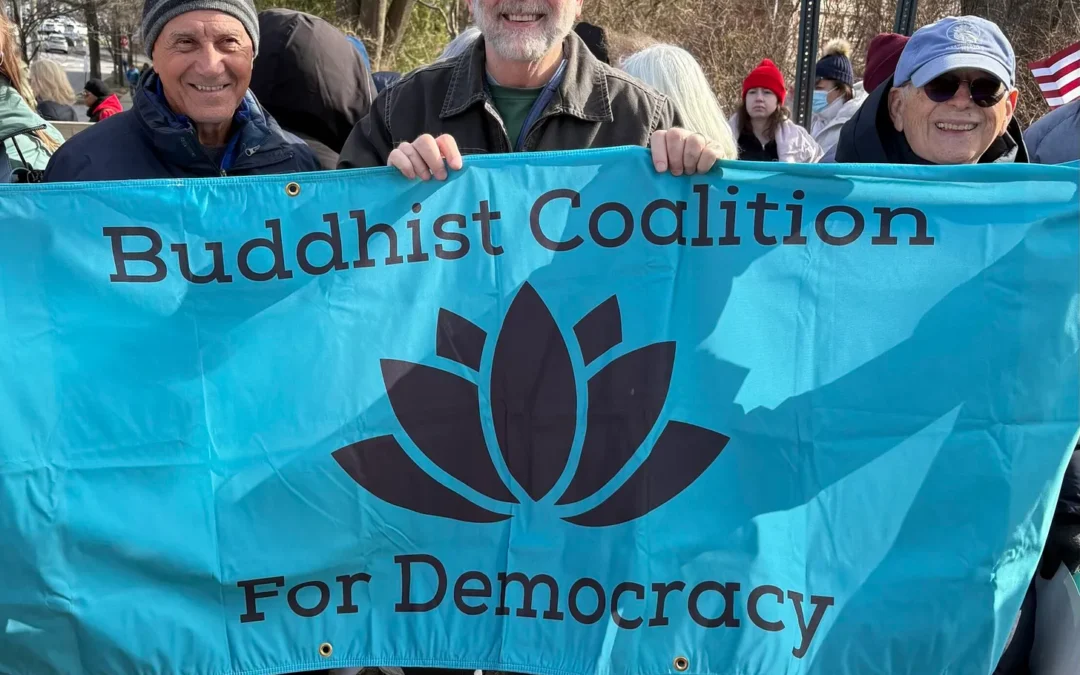
Why is it mostly boomers who show up at No Kings Day rallies? Where are all the college students? Why, when we old folks were college students, we were out there protesting the Viet Nam War. What is it with kids today?
I’m told today’s youth has soured on peaceful protests. They tried them during the wave of campus pro-Palestinian demonstrations. They believe nothing came of them, and participants were dealt with harshly by campus, local, and federal authorities. The backlash against those demonstrations has frightened some into passivity and quiescence. This essay isn’t the place to relitigate the ways that the campus Pro-Palestinian movement at times took stances, used rhetoric, or engaged in actions that undermined their own effectiveness and alienated the public, but only a place to note the lesson many campus protestors drew from their experience.
I’m also told that some of today’s progressive college students prefer “direct action” to peaceful protest. They want to shake things up. Peaceful protest is such a boomer thing! [And at times it is. I cringe when I attend a protest and someone breaks out a guitar to lead everyone in an old Woody Gutherie song. I like Woody sure enough, but there’s something terribly retro about it all. You’ll never attract Gen-Z that way!]
What is meant by “direct action?” Some of us are old enough to recall the “direct actions” of the Weather Underground and Symbionese Liberation Army. They created havoc and made headlines but did nothing to usher in a better world. They failed to engage the sympathy of the larger public who were repelled by their law-breaking and violence. Their violent resistance was crushed—the only way their story could end— by the vastly superior force of the state.
On the other hand, direct action can also mean nonviolent action, like the actions of Minnesotans during the ICE occupation. The Minnesotan resistance involved a broad swath of the community and had concrete, visible targets and a realizable aim. It worked because it aroused the public’s sympathy and rapidly crystalized public opinion. But the fact is, college students cannot accomplish this kind of direct action ensconced on campuses and working on their own. They can only be effective if they’re part of a broader resistance cutting across age, social class, ethnic, racial, and religious divisions.
As a veteran of the anti-Viet Nam and anti-Iraqi War protests, I never thought our demonstrations alone would magically bring an end to those conflicts. I hoped they would gradually bring about a sea change in public opinion, and that public opinion would eventually alter the length and conduct of those wars. Demonstrations and adverse events on the battlefield did succeed in turning public opinion, although both wars dragged on for what seemed like an eternity.
The Pro-Palestinian demonstrations and news coverage of the plight of Palestinians has had a significant impact on American public sentiment regarding Israel and Palestine, but many of the students who participated in those demonstrations view them as failures because they didn’t change American or Israeli policy. It’s hard to take the long view of things or remain undiscouraged when change proceeds at a glacial pace—but that’s how social change almost always proceeds: at first painfully slow, and then suddenly all at once. Social movements— like the abolitionist and suffragette movements—often take many decades to achieve their initial aims. Even when those initial aims are finally accomplished—ending slavery, obtaining the vote—they are just waystations on a longer journey towards greater social justice—a journey that is never complete.
As Buddhists, we understand the value of never-ending practice. The Buddhist project may take many lifetimes. We do not get discouraged when we sit for an hour, a year, or a lifetime and do not become Buddhas. We just keep showing up for practice.
It’s the same with engaged Buddhism’s approach to creating a peaceful, harmonious world. We keep showing up, bearing witness, and acting compassionately. This is our task whether the world seemingly yields to our efforts or not. I’m fond of Shōhaku Okumura’s metaphor that the bodhisattva’s vow to save all beings is like the vow to empty the ocean one teaspoon of water at a time. It seems a hopeless task, and yet we do it. And the world is a better place because we persist; without this Sisyphean effort, humanity sinks to its lowest level.
I don’t know how we get young people more involved in joining peaceful actions to protect and enlarge democracy and protest aggression abroad, but we need to find a way to break through their pessimism, cynicism, fear, and sense of powerlessness. The average college freshman today has been conscious of Donald Trump either being president or running for president for almost all of their politically aware lives. The world boomers grew up in which respresentatives and senators could stand up against a president of their own party and compromise was not yet a dirty word does not exist as part of their living memory. The job market today’s college graduates are entering is not the field of promise and possibility we boomers entered. The college debt they are burdened with is not the much smaller debt we were saddled with. The two-bedroom house I bought in Missouri after the birth of my first child for $27,000 dollars no longer exists. It’s hardly suprising if they take a dimmer view of things. I can understand if they can’t see the world and its possibilities the way I do.
The battle to protect and enlarge democracy is a forever battle—a continuation of a larger historical project that includes the abolitionist, suffragette, anti-colonial, labor, civil rights, gay rights, and trans rights movements and that spans centuries. It’s a campaign that’s never completely won but can easily slip away in moments of complacency. Every generation is obliged to take up the task anew. We must find ways to make the resistance appealing to young people.
Our task will only be won for our time and place if we’re all in it together.
At every No Kings event in Boston, there are more young people than at the previous event. At March’s event, I was canvassing for ACLU and spoke to many college students and recent graduates. A common theme was that after the recent punishment and doxxing of pro-Palestinian protesters, they are afraid to sign on to or turn out for political views that may come to harm them in the future.
As a boomer, the surveillance and data retention capacity that the government has now did not exist in the 60s and 70s. I did not have the same fear then as students do now.
Good point! Many of us boomers are post-career and are not as worried about doxxing as people just entering the work force must be.